 Machine-Win
1 / 1
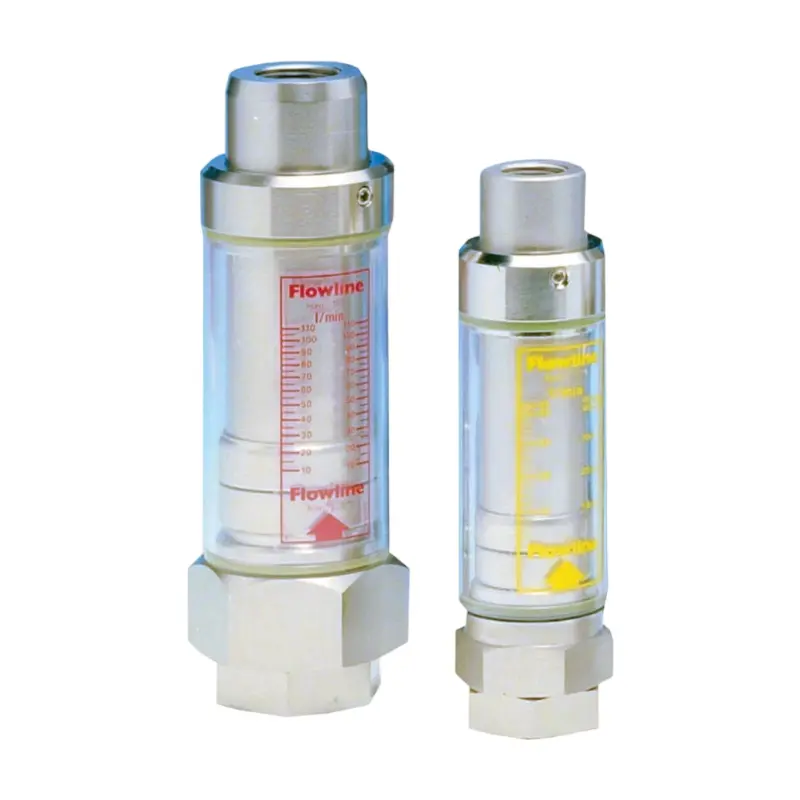
The Flowline series high-pressure mechanical flow meter is a durable online flow measurement device suitable for industrial hydraulic applications. Its core function is to provide intuitive monitoring of fluid flow in hydraulic systems.
Core Structure and Working Principle: It employs a variable orifice design, with a graduated observation sleeve on the outer casing. The internal piston and external indicating ring are magnetically coupled. During operation, utilizing the pressure difference across the piston, as the flow rate increases, the piston moves against the calibration spring, which in turn drives the indicating ring to move synchronously, thus achieving real-time flow feedback. The device can be installed on any plane, offering high installation flexibility.
Key performance parameters: Flow measurement range covers 1-360 L/min, adaptable to various flow requirements; maximum working pressure reaches 350 bar (5000 psi), capable of handling high-pressure environments; measurement accuracy is ±5% of full scale, repeatability is ±1% of full scale, and data stability is strong; operating temperature range is generally -20°C to 90°C, with some models extending to 105°C; it is relatively insensitive to changes in fluid viscosity, and measurement stability is unaffected by small fluctuations in fluid viscosity.
Core materials and specifications: Housing options include brass or stainless steel; seals are made of fluororubber, suitable for various fluids including oils; connection methods mostly use BSP straight threads, with port sizes available in 1/2 inch, 3/4 inch, etc., depending on the model; for example, model FM26322212 has a 3/4 inch BSP port. Some models weigh only 0.4 kg, facilitating installation and layout.
Applicable Scenarios and Additional Advantages: Suitable for industrial chemical processing, industrial manufacturing equipment, and other fields, especially for flow monitoring in hydraulic systems. It can also be used in hydraulic testing units to help quickly diagnose hydraulic circuit faults. Furthermore, this series of flow meters supports calibration with oil or water media, and some models can be upgraded with reed switches to further expand functionality and meet monitoring and control needs under different operating conditions.
| Specification Items | Details |
|---|---|
| For Fluid Type | Water, Oil |
| Operating Pressure | 5000 psi, 350 bar |
| Industry | Industrial & Chemical Processing, Industrial Manufacturing Equipment, Off-road Machinery |
| Materials of Construction | Stainless Steel, Brass |
| Body Material | Stainless Steel BS 2056 EN 58J, Nickel Plate, Brass |
| Operating Temperature | -4 to 221 °F, -20 to 105 °C |
| Technology | Filtration |
| Product Type | Condition Monitor |
| Product Style | Flow Meter |
| Flow Rate | View part number for details. (L/min) |
| Port Size | View part number for details. (inch) |
| Port Type | BSP Parallel Threads |
| Sensing Method | Variable Orifice Flow Meter |
| Accuracy | +/- 5% FSD |
| Specifications Met | Pressure Directive |
| Seal Material | Fluoroelastomer |
| Height | View part number for details. (mm) |
| Length | View part number for details. (mm) |
| Width | View part number for details. (mm) |
| Diameter | View part number for details. (mm) |
Delivery information typically includes delivery times, shipping methods, packaging, etc., which may vary depending on the seller and the location of purchase.

The Flowline series is designed for high-pressure industrial environments, with a maximum allowable working pressure of up to 350 bar (5000 psi).
The device is highly versatile and calibrated for both water and oil media. It is commonly used in industrial hydraulic and chemical processing applications.
Yes. Thanks to its internal piston and spring-calibrated magnetic coupling design, the flow meter can be mounted and operated in any orientation or plane.
It features a measurement accuracy of ±5% of the full-scale deflection (FSD) and provides a strong repeatability rating of ±1% FSD.
The Flowline series is relatively insensitive to viscosity variations. Within a viscosity range of 10 to 200 cSt, its measurement stability remains highly reliable.