 Machine-Win
1 / 1
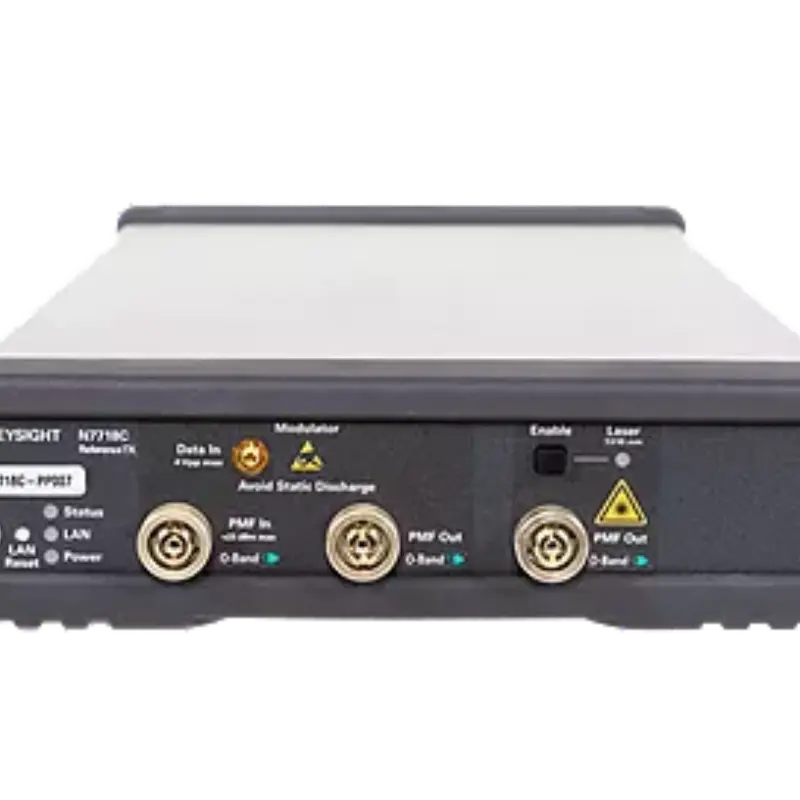
The Optical Reference Emitter supports any intensity-modulated signal format at rates up to 120 Gbaud and beyond. This device operates in the O-band (1.3 μm window). Users can connect optical inputs to the built-in 1310 nm DFB laser or a tunable laser to cover LR4, ER4, CWDM4, or other wavelength grids. The Optical Reference Emitter works in conjunction with the Arbitrary Waveform Generator (AWG) and Bit Error Rate Testers (BERT).
Optical transceiver manufacturers and optical interconnect solution providers need to validate standard compliance and ensure interoperability at data rates exceeding 200 Gbps per channel. Concurrently, research on 400 Gbps per channel data rates is already underway.
The turnkey optical receiver stress test solution comprises the BERT and the Optical Reference Transmitter. This enables optical receiver designers to bypass fixed-signal-quality internal transmitters by simulating a 120 Gbaud optical transmitter to validate receiver performance under variable conditions. These conditions include optical extinction ratio and TDECQ, as well as stress factors like noise, jitter, and interference.
Driven by the BERT, the optical reference transmitter generates both clean and stressed signals. This solution automatically tests optical receiver designs for compliance with the upcoming IEEE 802.3dj standard.
When paired with the AWG, the optical reference transmitter generates intermodulation loss (IM-DD) signals such as NRZ, PAM4, PAM6, and PAM8 waveforms. This capability supports research into 400 Gbps per channel transmission, paving the way for 3.2 Tbps links.
The transmitter's low Vpi characteristics eliminate the need for RF amplifiers that may introduce jitter, enabling users to achieve purer optical signals.
The automatic bias control mode operates jitter-free at the orthogonality point, preventing the injection of any extraneous spectral components into the optical signal.
| Parameter | Specification Value (N7718C) |
|---|---|
| Optical laser output | Angled, Panda PMF, 9/125 μm; requires 81000xl connector interface |
| Optical (laser) input | Angled, Panda PMF, 9/125 μm; requires 81000xl connector interface |
| Optical (data) output | Angled, Panda PMF, 9/125 μm; requires 81000xl connector interface |
| RF input | 1.0 mm female, single-ended |
| Line power | AC 100 V to 240 V ± 10%, 50/60 Hz, 60 VA max |
| Operating temperature | +5°C to +40°C |
| Operating humidity | ≤ 80%, non-condensing |
| Storage temperature | -40°C to +70°C |
| Max. operating altitude | 2000 m |
| Warm-up time | 30 minutes |
| Recommended recalibration period | 2 years |
| Dimensions | 420 mm x 212 mm x 43 mm (excluding front and back rubber cushions and connectors) |
| Weight | 3 kg (6 lbs) |
| User Interface | Interface Specifications |
| LAN Access (1 Gbit/s): HTTP, VXI-11, SCPI-telnet, SCPI-raw, HiSLIP |
IPv4 and IPv6 Socket connection: port 111 (IPv4 only) port 5024 port 5025 port 4880 |
| USB Access (USB 2.0) | Remote NDIS (virtual Ethernet link over USB); USB Mass Storage functions (read-only); USBTMC |
| Product Option | Description |
| N7718C | Optical Reference Transmitter, single mode with external optical input |
| Option - Bandwidth Selection | Must choose one |
| N7718C-313 | For 120 GBd and higher, O-band operation |
| Option - Laser Selection | Must choose one |
| N7718C-100 | With integrated 1310 nm DFB laser and external optical input |
| N7718C-050 | With external optical input |
N7718C Optical Reference Transmitter: Single-mode fiber optical reference transmitter enables 200G-per-lane design validation and 400G-per-lane research.
Delivery information typically includes delivery times, shipping methods, packaging, etc., which may vary depending on the seller and the location of purchase.

A1: It supports any intensity-modulated signal format at rates up to 120 Gbaud and beyond, operating in the O-band (1.3 μm window).
A2: No, it features low Vpi characteristics that eliminate the need for RF amplifiers. This helps avoid the introduction of jitter and yields purer optical signals.
A3: The automatic bias control mode operates jitter-free at the orthogonality point, preventing the injection of any extraneous spectral components into the optical signal.
A4: Driven by the BERT, the solution automatically tests optical receiver designs for compliance with the upcoming IEEE 802.3dj standard.
A5: The main body dimensions are 420 mm x 212 mm x 43 mm (excluding front and back rubber cushions and connectors), and it weighs approximately 3 kg (6 lbs).
A6: It supports LAN Access (HTTP, VXI-11, SCPI-telnet, SCPI-raw, HiSLIP via IPv4 and IPv6 sockets) and USB Access (Remote NDIS, USB Mass Storage, and USBTMC).