 Machine-Win
1 / 1
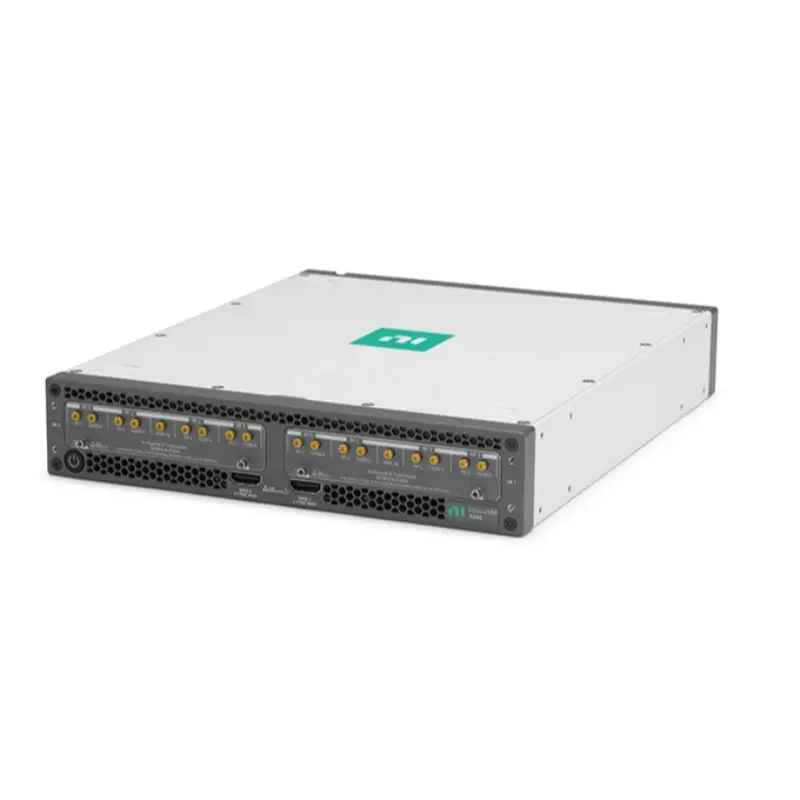
The NI Ettus USRP X440 is a high-performance, scalable software-defined radio (SDR) device designed for wideband wireless research, prototyping, and commercial deployment. As part of the Ettus Research product line (a leader in SDR technology), it combines ultra-wide frequency coverage, high data throughput, and flexible software integration—making it ideal for applications like 5G/6G research, radar systems, satellite communications, and wireless signal intelligence.
The USRP X440's hardware architecture prioritizes modularity and ease of integration, adapting to diverse test and deployment needs:
A key strength of the USRP X440 is its seamless integration with software tools and open-source SDR frameworks, enabling rapid prototyping and deployment:
Fully supported for graphical programming via LabVIEW's SDR Toolkit to build custom Tx/Rx waveforms, and the USRP Hardware Driver (UHD) for low-level access to hardware settings on Windows, Linux, and macOS.
Works with popular open-source SDR tools including GNU Radio for building custom wireless protocols, and MATLAB/Simulink via the UHD driver for algorithm development and signal classification.
For production-scale applications, the USRP X440 can be paired with LabVIEW Real-Time for deterministic, low-latency processing, or integrated into custom systems via Linux-based runtime.
| Specification Category | Details |
|---|---|
| Product Model | Ettus USRP X440 |
| Device Type | Wideband Software-Defined Radio (SDR) for research, prototyping, and commercial deployment |
| Frequency Range | 70 MHz – 7.2 GHz (baseband); extendable to lower/higher bands via optional external upconverters/downconverters |
| Instantaneous Bandwidth | Up to 200 MHz per Tx/Rx channel (maximum bandwidth supported for real-time IQ data streaming) |
| Transmit (Tx) Channels | 2 independent Tx channels (2×2 MIMO capable) |
| Receive (Rx) Channels | 2 independent Rx channels (2×2 MIMO capable); expandable to larger MIMO configurations via multi-device synchronization |
| Tx Performance |
• Output Power (P1dB): ≥ 10 dBm (typical at 2 GHz) • Harmonic Distortion: ≤ -50 dBc (typical at 1 GHz, 0 dBm output) • Spurious Emissions: ≤ -60 dBc (typical, outside signal bandwidth) |
| Rx Performance |
• Noise Figure (NF): ≤ 3 dB (typical at 1 GHz) • Input Third-Order Intercept Point (IIP3): ≥ 15 dBm (typical at 1 GHz) • Dynamic Range: ≥ 70 dB (typical, over 200 MHz bandwidth) |
| RF Front-End | Dual Qorvo QPD6020 wideband transceivers (RFICs); integrated low-noise amplifiers (LNAs), power amplifiers (PAs), and filters |
| RF Connectors | SMA female connectors (1 per Tx channel, 1 per Rx channel); SMA male for 10 MHz reference clock input/output |
| Host Interface | 100 GbE (Ethernet) port (SFP28 connector); supports real-time IQ data streaming up to ~2 GB/s |
| Synchronization |
• Reference Clock: 10 MHz external reference (input/output) • Trigger: PPS (Pulse-Per-Second) trigger input/output for multi-device synchronization (MIMO expansion) • GPSDO option: Optional GPS-disciplined oscillator for precise time/frequency synchronization |
| Power Requirements | 12 V DC input; typical power consumption: 30 W (operating), 5 W (standby) |
| Form Factor | Desktop/rack-mountable; 1U rack height (optional rack ears); dimensions: 254 mm (W) × 178 mm (D) × 44 mm (H) (10 in × 7 in × 1.73 in) |
| Weight | ~1.5 kg (3.3 lb) (net weight, excluding cables and accessories) |
| Operating Temperature | 0 °C – 50 °C (32 °F – 122 °F); storage temperature: -40 °C – 70 °C (-40 °F – 158 °F) |
| Software Compatibility |
• Drivers: USRP Hardware Driver (UHD) v4.0+ (supports Windows, Linux, macOS) • Programming Environments: LabVIEW (with SDR Toolkit), GNU Radio, MATLAB/Simulink, Python (via UHD bindings) • Real-Time Support: LabVIEW Real-Time, Linux RT |
| Calibration | On-board automated calibration (gain, phase, frequency); recommended calibration interval: 12 months |
| Compliance Standards |
• EMC: EN 61326-1, CISPR 22 Class A • Safety: IEC 61010-1, UL 61010-1, CSA C22.2 No. 61010-1 • Environmental: RoHS 3 compliant |
| Included Accessories | 100 GbE SFP28 transceiver module, 12 V DC power supply, power cable, quick-start guide |
| Optional Accessories | External GPSDO (for precise synchronization), 1U rack ears, high-performance 100 GbE cables, external upconverters/downconverters (for extended frequency range) |
Ettus USRP X440 Software Defined Radio Device
MHz to 4 GHz, 1.6 GHz Bandwidth, GPS-Disciplined OCXO, USRP Software Defined Radio Device.