⚡
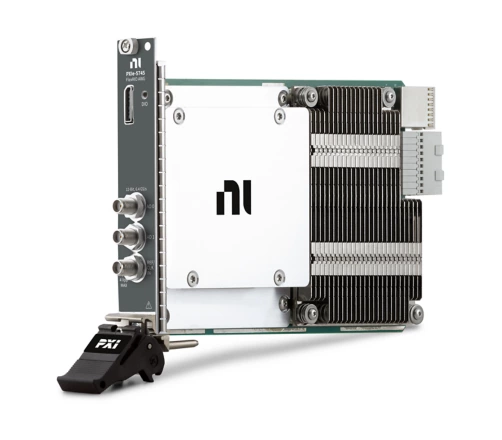
The PXIe-5745 facilitates direct radio frequency (RF) production reaching 3 gigahertz (GHz), boasting a resolution of 12 bits. It can be operated in a two-channel configuration at a rate of 3.2 gigasamples per second (GS/s) to generate signals up to 1.5 GHz, or in a single-channel wideband upconversion setup at 6.4 GS/s. This device is well-suited for scenarios demanding high channel density intermediate frequency (IF) signal creation paired with multichannel alignment—such as radar systems, electronic warfare operations, and communication networks. The FlexRIO software driver offers compatibility for producing preconfigured waveforms, while the LabVIEW-programmable Xilinx Kintex UltraScale field-programmable gate array (FPGA) allows for on-the-fly waveform development, signal modulation and demodulation, as well as other tailored real-time signal processing tasks.
Frequently Asked Questions
What is the maximum RF output frequency supported by the PXIe-5745?
The module supports direct radio frequency (RF) production reaching up to 3 gigahertz (GHz) with a 12-bit resolution.
What sample rates are available in single and dual channel configurations?
It can generate signals in a two-channel configuration up to 1.5 GHz at a rate of 3.2 GS/s, or in a single-channel wideband upconversion setup at 6.4 GS/s.
Which applications are ideal for this device?
It is highly suited for high channel density intermediate frequency (IF) signal generation and multichannel alignment, commonly required in radar systems, electronic warfare, and communications.
What kind of FPGA is embedded on the PXIe-5745?
The module features a LabVIEW-programmable Xilinx Kintex UltraScale FPGA (available in KU035, KU040, and KU060 models depending on configuration) for customizable real-time processing.
What are the physical dimensions and weight of the module?
It is a 3U, one-slot PXI Express module measuring 21.6 cm × 2.0 cm × 13.0 cm (8.5 in. × 0.8 in. × 5.1 in.) and weighs approximately 490 g (17.3 oz).
 Machine-Win